Thursday, February 16, 2012

My Blog About How is Technology Changing

How Technology is Changing School Blog
https://www.google.com/


I found it really interesting that Gov. Schwarzenegger from California is seeking for ways to incorporate digital books in the classroom rather than textbooks will help solve the states deficit problem.  I can only hope that more schools will follow suit.  Yes, it would save money, paper, toner, and clerical expenses.  More prominent of a factor for me, as the teacher, is the time it takes to copy all the materials that I need for the week.  I spend at least 2.5 hours in the copying room.  Time I could be spending on creating fun and engaging lessons, or helping Tier 2 students.  Our school did not purchase consumable workbooks for my grade, but other grades got all the consumables they asked for.  There is no definite amount each grade gets for budget.  Administrators can be subjective and allow certain grades to have more.  Do you feel this is fair and what could a teacher with no say on how budget is spent address this issue without sounding like a complainer?  


https://www.google.com/
I can imagine the future when all students can access any online text, activity, game, or reference with a handheld devise.  Just imagine...it's spring, the warm sun is beating down on your head as you teach our class with the latest downloaded digital book.  All reading in the fresh air and enjoying learning.  Mobile learning is extremely inviting and seems like it would be a great motivator for students.  


**See the video below for how one teacher uses handhelds in the classroom.  

Kids and Handhelds


In this video I found on You Tube, students are asked what difference using handhelds has made to their learning.  I was intrigued by their responses.  The CEO, of GoKnow Inc. Mr. Elliot Soloway helps listeners understand why handhelds have so many advantages.  They help students take control of their own learning, it allows for collaboration, and helps to organize.What do you think?

Wednesday, February 15, 2012

Blogging About Ch 1-3 in Alan November's Book

Empowering Students with Technology 
Blog for Preface, Introduction, & Chapters 1-3
https://www.google.com/
Honestly...I have always been somewhat apprehensive about teaching with technology.  My daughter has a technology teacher separate from her classroom teacher.  In my school the classroom teacher is responsible for the weekly lessons.  I see this book as a catalyst into my journey as a student and teacher.  The possibilities are extremely clear and attainable. As Mihaly Csikszentmihakyi (1991) would say about Yves, "he was into the flow of an optimal experience."  I can connect with Yves, Mr. November's former high school student, when he felt he could work better on his own terms.  I was really in a great flow when I was creating my Animoto.  It was bringing back memories and allowed for creativity.  I was having fun and I didn't want to stop.  When I shared the Animoto with parents they were amazed and were excited about how technology was being used.  
http://images.search.yahoo.com/
A couple of common statements you'll hear me repeat throughout the day to my students are, be a problem solver, look it up, and three before me (3B4Me).  I encourage them to ask each other questions and to peer tutor.  I see why it's important to shift control and empowerment.  Students love to learn from their peers and from different people.  One of my former students began her love for poetry by using an interactive online poetry tool.  She would write several poems a week at school and began to love it so much she would go home and continue writing poems to share with the class the next day at snack.  It became like a virus and others joined in  but nothing matched her enthusiasm.  It was cute!  I hope you like the website.  
https://www.google.com/
 I love being able to access my son's records daily.  His high school, uses PowerSchool and it's been very helpful in keeping me informed of his grades, attendance,  homework, and connected with his teachers.  I would hope that the administrators in my school get a chance to read Mr. November's book.  If a very compelling reason to informate is competition...maybe it won't be long before the competition gets serious and technology becomes commonplace in every class.  Reality and a reminder of a book I read during my Undergraduate class titled Savage Inequalities reminds me that not every school budget is equal.  Some districts have plenty of money and others skrimp by.
http://images.search.yahoo.com/
Anatomy of a web address, new to me!  I learned how to read the structure of a URL to help me determine validity of a site.  When I asked my son if he knew what the tilde~ in a web address means...he said no.  He has never been taught how to read the structure of a URL, and like I've said he's in high school.  How can learning about URL's and their structure be simplified and developmentally appropriate for young learners?  Are there any simple sites or tutorials for teaching URL structure, testing/checking for validity, and assessing purpose?

http://static.flickr.com/110/275042551_2d85d00577.jpg
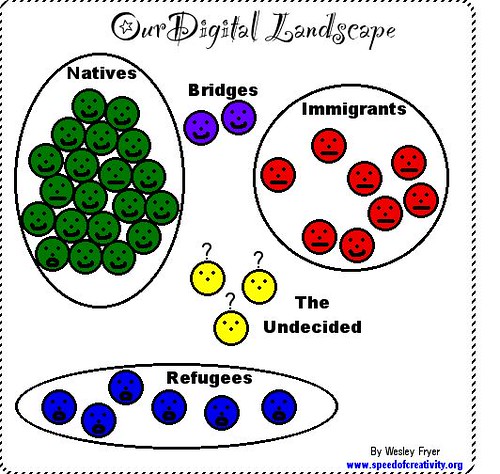
Hello, my name is Michelle Klock and I am a digital immigrant. I have something in common  Lisa, we both took used electronic typewriters in college. I guess we're both digital immigrants.  A digital immigrant is anyone who was born before digital technology was widely adopted.  Digital immigrant may also apply to those who were not exposed to computers or technology at a young age. My children and class are digital natives.  They have had technology in their lives since they were babies.  I know that everyday I am pushing myself to  improve professionally.  Yes, the "real bottleneck to creative use of technology," as Mr. November stated, is staff development and time.  Of course money comes into play for my district, but these are hurdles worth leaping in my opinion.  I think it would be the most amazing feeling to experience my student as my teacher.  Have you ever experienced that feeling?


A Vision of K-12 Students Today


This YouTube video digitally represents many thought provoking questions and gets you thinking about the importance of using technology in and out of the classroom.  I just loved it and wanted to share.

Sunday, February 12, 2012

Second Blog for Class 3


I chose to explore Digital Storytelling because I find it interesting and I see how it could motivate my class to enjoy literacy. I examined and found that it is definitely a tool that I will use in my classroom. I saw the Digital Story titled Imagine on GoAnimate made by a student and the ideas came pouring in. I would love to create a lesson for inferencing. Inferring is a difficult comprehension strategy for most students. I tested this lesson on my daughter, who is also in third grade. I know...How convenient! When the image and phrase came up I asked to to make an inference based on the image. Then she compared the text answer to her own. It was cute because she was often correct in her response. For my class implementation I would project the GoAnimate video and pause it for either discussion, or for them to respond in their journal or on a whiteboard. Inferring is a weak skill for my class and getting them to use a visual representation rather than only my direct instruction will be fun. Later, if time permits, we can create our own GoAnimate on Inferencing.  A couple of her comments were "Love at first sight" for the True Love Happens phrase and "Peace not war" for the Help Always Comes phrase.  I can see how this will bring out teachable moments of discussion.  
http://www.catawbaschools.net/schools/Oxford/staff/Rachel_Lamb/Web%20Page%20Library/Reading%20Resources.aspx 


First Blog for Class 3

First Blog Assignment Class 3


When searching through all the great digital resources that are available on the Free Resources for Your Class Link, I had a difficult time deciding which resource I would apply to my current teaching. I decided I would focus on the specific needs of my students right now. Recently they took an assessment and did poorly on the Grammar section, specifically the possessive noun portion of the test. Despite all the examples, games, and practice, they still didn't understand when to add the apostrophe. 
http://aacton.gladbrook.iowapages.org/sitebuildercontent/sitebuilderpictures/grammarladywatching.jpg 
My first skill I chose to blog about is a hyperlink from Classroom Literacy Resources. I clicked on the Literacy topic, Writing and found a fantastic site I could plan to incorporate into my class this week in our computer lab.  April Acton's site called, The Grammar Lady is a great site to get kids thinking about possessive nouns through a project called “Apostrophe Abuse”. There are pictures of real life erroneous application of possessive nouns and answers to most common mistakes with possessive nouns. I think it will be a fun way to create an ongoing search for real life misuse of apostrophes. They can look on signs, in newspapers, magazines, online, etc. They will be expected to record and report to the class what they find. Letters, or better yet, emails can be sent to businesses that have the errors printed. I plan to show this website to my class and have a discussion about each incorrect usage. I liked how she will respond to specific questions from students or teachers. My class will be on the hunt for “Apostrophe Abuse”. 
The following quote from the National Council of Teachers of English on Mrs. Acton's Grammar Webpage articulately explains why I would want to help my class learn the correct use of the apostrophe. “Grammar can be part of literature discussions, when we and our students closely read the sentences in poetry and stories. And knowing about grammar means finding out that all languages and all dialects follow grammatical patterns.”  

https://www.google.com/
The second website I found to be a great match for my current lessons involves integrating Science, Technology, Literacy, Math and Art. Through a WebQuest at http://webquest.org/index.php integration of subjects proves seamless. This is a fabulous website, and I plan to introduce its contents this week. We are currently studying the Solar System in Science and Comparing and Contasting in Reading. This WebQuest combines both concepts into a fun,interactive, web-based lesson. I provided the link http://www.kidsastronomy.com/on my school webpage for easy access to use at school and home. See the Full Web Quest Lesson Plan rubric and extension ideas.
I like that my students will work in pairs and collaborate on the project. I would consider using a Digital Story or Animoto instead of a Powerpoint for the Presentation. I'm planning on researching the presentation piece to see which program to use. Students' literacy skills will be enhanced because they need to read all the Fun Facts about their specific planet. They'll need to answer some of the following questions: What is the planets Position to the sun? Is it an Inner or Outer planet?
Other questions about Rotation, Revolution, Diameter, Temperature in Celsius & Fahrenheit and Travel time from earth. They can be creative. I will use a program called KidPix for them to represent their planets through art. I know my class will love this assignment. I'm excited to use and share with my colleagues.
https://www.google.com/


Wednesday, February 1, 2012

Week 2 Readings, Activities & Videos

Yes, the internet has made a huge impact on the 21st century.  You can have the greatest training and still won't be current with what is to be learned about the Internet.  The internet transforms so frequently, who can keep up?  The resources available as a teacher are amazing.  You can find a great resource website, such as superteacher.com one week, and download several lessons and activities, and the next week the website is charging a fee to access the same materials as a week before.  As a district with no monies left in our current budget, we teachers end up footing the cost.  It is a fact that the internet is transforming the way children communicate.  Our district recently banned Facebook in school.  No student can access Facebook from the school property.  I do not agree with this practice.  I remember being a teenager and my social interactions tended to dictate my moods and motivations.  I went to my friends for advise and support, not my parents or teachers.  I valued my peers opinions greatly.  Getting students to communicate in any means available is a good thing.  Why would anyone take someone's voice away?
http://images.google.com
                                                                     

Use what youth is comfortable with to learn and expand their voice. When I was my students age, I used an encyclopedia for research reports.  When I asked my students what an encyclopedia was, they had never heard of one.  My class will go to dictionary.com before looking up a word in the book form of a dictionary.  They are comfortable with the ever changing resource that they have available at their fingertips. Framing Internet as a literacy issue would bring the importance of revamping standards to meet the students technological needs for their future to the for front.  As a teacher, I would love to have the standards integrate technology into subject area standards.  My third graders integrate Science and technology by doing quarterly Webquests.  They love them and are motivated to learn and explore information from various topics.  This quarter it's the Solar System!  One of my favorite units to teach.  Does anyone know of any good Solar System websites that are informative, better yet interactive?


 I'm optimistic with the changes in standards, the focus switching to a more inquiry based learning and assessment as opposed to factual knowledge.  Yes, today's classrooms focus on making sure students do well on the CMT's.  It's a factual test, no manipulatives, no verbal or creative component.  There is more to a student than if they do well on a series of tests in the month of March.  From what I've learned so far is the new CCSS Standards look at the student as a learner. I haven't heard of technology portion, but I do know that the Assessments will be computerized.   What do you know about the new CCSS standards and how this will change the way in which we teach?

http://images.google.com
I explored and watched the different activities.  It was very fun creating my first Animotos. Once I started I didn't want to stop.  I already have so many different ideas on how I would like to incorporate Animoto and StoryTelling into my teaching. The possibilities are endless.  My class really loves using the computer.  They feel free to be creative and expressive. They will definitely be motivated to learn any lesson that is on the computer.  I shared the Digital Story about the 5 elements of good stories with two out of the three third grade classes in my school.  After the lesson, most students could remember what each element was.  Even getting to watch that video as a whole class was a challenge.  Funding is a huge issue when it comes to Technology for our school.  It may take a little more time because I only have four computers in my classroom, but I am looking forward to utilizing these great resources.  One project I have in mind is Digital Stories about the Solar System.  They will work collaboratively, which they love to do and have already proven to be good peer tutors.  They learn so much from each other, and I love to listen to them teach one another.  It's said that the greatest way to learn something is to teach it.  I agree with this statement. Do you?